
Wall Sits Beat Cardio for Blood Pressure: The 8-Minute Fix
For forty years, standard medical advice for high blood pressure has sounded like a broken record. You sit on a paper-lined exam table, the cuff squeezes your arm, and the doctor frowns at a reading of 138/88 mmHg. The prescription? Lace up your running shoes. Walk 10,000 steps a day. Jog on a treadmill until your knees ache. Eat less sodium.
That rarely works. At least, not quickly enough to rescue your microvasculature from progressive damage.
Cardiologists have treated aerobic cardio as the gold standard of vascular therapy since the 1970s. I track my own VO2 max obsessively, and I love endurance work, but clinical reality has moved on. A live report in The Washington Post highlighted what exercise physiologists have documented across hundreds of trials: isometric exercise—specifically the static wall sit—dwarfs aerobic cardio, lifting weights, and high-intensity interval training for slashing resting blood pressure.
Let that sink in. You do not need to pound the pavement for forty-five minutes to soften your arteries. You need eight minutes of quad-shaking stillness against a wall.
We need to talk about why this happens, the physiological mechanisms at play, and the exact protocol to run this week.
The Canterbury Meta-Analysis That Shattered Orthodoxy
The medical establishment moves at a glacial pace. If you want proof, look at how long it takes for landmark trials to reach primary care clinics. In a massive study published in the British Journal of Sports Medicine, Dr. Jamie Edwards and his team at Canterbury Christ Church University analyzed 270 randomized controlled trials conducted across thirty-three years, covering 15,827 human participants.
They compared every major exercise category to find which protocol produced the largest drop in resting blood pressure. The results shocked clinicians who spent decades preaching cardio above all else:
- Aerobic Endurance Training (jogging, cycling, walking): lowered systolic pressure by 4.49 mmHg and diastolic by 2.53 mmHg.
- Dynamic Resistance Training (standard weightlifting): lowered systolic pressure by 4.55 mmHg and diastolic by 3.04 mmHg.
- Combined Training (cardio plus weights): lowered systolic pressure by 6.01 mmHg and diastolic by 2.54 mmHg.
- High-Intensity Interval Training (HIIT): lowered systolic pressure by 4.08 mmHg and diastolic by 2.50 mmHg.
- Isometric Exercise Training (static wall sits and handgrip holds): crushed every other category, driving an average drop of 8.24 mmHg in systolic and 4.00 mmHg in diastolic pressure.
Static wall sits produced nearly double the systolic reduction of traditional jogging. Zero miles logged. Zero joint impact.
An 8.24 mmHg drop is clinically massive. A 5 mmHg decrease in systolic pressure cuts stroke mortality by roughly 13% and reduces overall cardiovascular disease risk by 10%. An eight-point reduction matches or beats first-line antihypertensive drugs like Lisinopril, Amlodipine, or Losartan. You get pharmaceutical-grade vascular protection without dry coughs, swollen ankles, or electrolyte crashes.
The Hemodynamic Trap: What Happens During a Wall Sit
Why does holding completely still against a wall outperform a 45-minute sweat session on an elliptical? It comes down to vascular physics, mechanical intramuscular pressure, and a phenomenon called reactive hyperemia.
Think about what happens inside your legs when you run. Your quadriceps contract and relax rhythmically. When the muscle relaxes, blood flows into capillary beds; when it contracts, it pumps blood back toward your heart. This "skeletal muscle pump" assists venous return. Your heart rate climbs, but peripheral vessels dilate to accommodate the volume. Total peripheral resistance falls. It is a smooth, well-tolerated biological loop.
Now drop into a 90-degree wall sit. The biomechanics turn hostile.
Your quadriceps, hamstrings, and gluteal muscles contract statically. There is no relaxation phase. Intramuscular pressure climbs rapidly, surpassing the systolic perfusion pressure of your femoral arteries. The mechanical squeeze collapses your intramuscular arterioles and capillaries.
Blood flow downstream drops to a trickle. You have created an intentional zone of localized ischemia.
Within thirty seconds, oxygen inside the working tissue is depleted. Anaerobic metabolism takes over. Local metabolites pool: hydrogen ions, adenosine, inorganic phosphate, potassium, and lactate. Your quads burn like fire. Your brain screams at you to stand up. It feels brutal.
Then, at the two-minute mark, your timer beeps. You stand up.
That is where biological adaptation occurs.
The Nitric Oxide Surge and Endothelial Remodeling
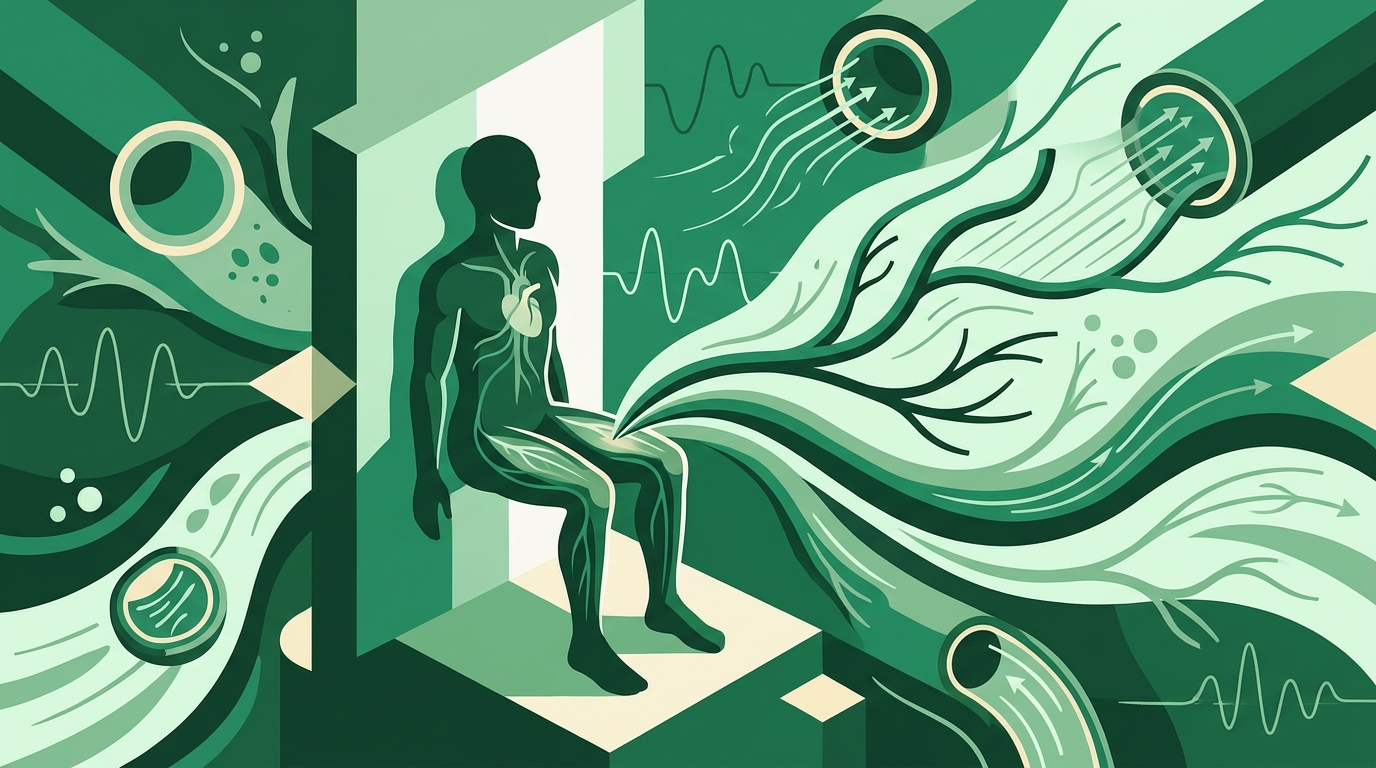
The instant you stand up and unload the muscle, mechanical compression disappears. Downstream vascular resistance plummets to near zero. A massive tidal wave of pressurized blood rushes back into the starved capillary beds. In cardiovascular physiology, this surge is known as reactive hyperemia.
As this volume of blood roars through constricted arterioles, it exerts intense frictional drag across the inner lining of the blood vessel wall. This physical friction is called fluid shear stress.
Your vascular endothelial cells are sensory organs. They detect that mechanical shear stress through specialized structures along their membranes called caveolae. This physical distortion sends an immediate biochemical signal: it phosphorylates endothelial nitric oxide synthase (eNOS) at its serine-1177 residue.
Once activated, eNOS converts circulating L-arginine into nitric oxide (NO) gas.
Nitric oxide is your body’s master vasodilator. It diffuses out of the endothelium and into surrounding vascular smooth muscle cells. There, it binds to soluble guanylyl cyclase, converting guanosine triphosphate (GTP) into cyclic guanosine monophosphate (cGMP). That surge of cGMP directs smooth muscle cells to evacuate calcium ions. Without intracellular calcium, muscle fibers cannot clamp shut.
The blood vessels relax completely. They dilate wider than they were before the set began.
Repeat this ischemic-hyperemic cycle four times in a session, three days a week, and your vascular architecture permanently adapts. Blood vessel walls downregulate endothelin-1 (a potent vasoconstrictor peptide) and upregulate antioxidant enzymes like superoxide dismutase. Over six to eight weeks, arterial walls remodel. Carotid-femoral pulse wave velocity drops, meaning your arteries become compliant, supple, and biologically younger.
Autonomic Reset: Hijacking the Baroreflex
Vascular plumbing is only half the equation; your autonomic nervous system controls the rest. If your sympathetic nervous system is stuck in overdrive—fueled by chronic deadlines, poor sleep, and stimulants—your blood vessels stay clamped.
Isometric exercise pulls off an autonomic reset through the exercise pressor reflex.
While you hold a wall sit, specialized thin-fiber sensory nerves (Type III mechanoreceptors and Type IV metaboreceptors) embedded in your quadriceps detect the mechanical tension and the acidic pooling of hydrogen ions. They send urgent warning signals to the solitary tract in your brainstem.
Your brain fires a sympathetic volley, spiking norepinephrine to keep perfusion pressure alive despite the blocked vessels. Your heart rate jumps. Your systolic pressure spikes temporarily during the hold.
Do not fear that acute spike. It triggers the rebound.
The moment you stand up and ischemic pressure clears, your carotid sinus and aortic arch baroreceptors detect that sudden pulse wave. They fire an intense burst of inhibitory signals down to the brainstem. The brainstem responds by slamming the brakes on sympathetic outflow. Parasympathetic vagal nerve activity surges. Heart rate slows, and peripheral vascular resistance collapses.
Over weeks of training, this post-exercise rebound resets your resting baroreflex sensitivity. It shifts your baseline autonomic set-point downward. You spend more hours of the day in a calm, parasympathetic-dominant state. Your vessels stop clenching.
Wall Sits vs Isometric Handgrip: Choosing Your Tool
The Edwards meta-analysis highlighted two primary isometric modalities: the wall sit and isometric handgrip training (IHG). Many people wonder if they can simply buy an electronic handgrip dynamometer and squeeze it while answering emails.
Handgrip devices do work. Squeezing a dynamometer at 30% of your maximum voluntary contraction for four sets of two minutes produces an average systolic drop of roughly 5.5 mmHg. It is convenient, portable, and requires zero physical exertion from the rest of your body. If you travel constantly or suffer from severe knee osteoarthritis that prevents squatting, an isometric handgrip device is an outstanding tool.
However, if your joints allow it, the wall sit is far superior.
Your forearm flexors comprise a tiny fraction of your total muscle mass. Squeezing a handle creates localized shear stress in the radial and brachial arteries, but it cannot match the systemic impact of recruiting your lower body. Your quadriceps, hamstrings, and glutes represent vast vascular beds. When you occlude and release blood flow across your entire lower body, the resulting flood of reactive hyperemia and eNOS activation is systemic.
Wall sits also challenge core stability and lower-body muscular endurance. For longevity, maintaining quad strength and knee stability is a massive protective asset against age-related frailty.
The Modern Vitality Lab 12-Minute Protocol
You do not need gym equipment or fitness apps to execute this. You need a flat wall and a timer. Here is the exact protocol I follow and recommend:
1. Frequency and Scheduling
Perform this protocol three to four non-consecutive days per week (for example: Monday, Wednesday, Friday, Sunday). Avoid doing it daily; the vascular endothelial remodeling process requires recovery days to synthesize new proteins and recalibrate autonomic tone.
2. The Session Structure
- Total Sets: 4 sets.
- Hold Duration: Exactly 2 minutes per set.
- Rest Duration: 1 to 2 minutes of passive rest between sets.
- Total Working Time: 8 minutes of static tension.
- Total Session Time: 12 to 14 minutes.
3. Biomechanics and Setup
Stand with your back flat against a wall, feet shoulder-width apart, and heels placed approximately two feet out from the baseboard. Slide down until your thighs are parallel to the floor, creating a 90-degree to 100-degree angle at your hips and knees. Ensure your knees track directly over your second toe without caving inward.
Do not rest your hands on your knees or thighs. Resting your hands allows your upper body to offload your quads, dropping intramuscular pressure. Cross your arms over your chest or let them hang freely at your sides.
If you experience anterior knee pain, modify the joint angle. Slide up to a 110-degree or 120-degree knee angle for the first three weeks. As your patellar tendons adapt, gradually lower your hips until your thighs hit parallel.
4. Intensity Target
Set 1 should feel relatively easy for the first 60 seconds, progressing to a moderate burn by the end (Rate of Perceived Exertion: 6 out of 10). By set 3 and set 4, you should experience profound localized fatigue and involuntary muscular tremors during the final 30 seconds (RPE: 8.5 to 9 out of 10). If you finish set 4 without trembling, you are sitting too high.
5. The Breathing Rule (Crucial Safety Constraint)
Never hold your breath. Clamping your glottis while holding an intense isometric contraction triggers the Valsalva maneuver, causing a dangerous spike in intracranial and aortic pressure.
Practice rhythmic diaphragmatic breathing throughout the hold. Inhale through your nose for four seconds, and exhale smoothly through pursed lips for six seconds. This engages your vagus nerve and prevents acute hypertensive spikes.
Integrating Isometrics into Your Longevity Architecture
A common mistake in health optimization is treating every new scientific finding as a replacement for previous habits. People hear that wall sits crush cardio for blood pressure, so they abandon Zone 2 running entirely. That is a mistake.
Isometric training is not a substitute for aerobic fitness or heavy resistance training; it is the third pillar of vascular longevity. Think of your training architecture as a tripod:
- Zone 2 Endurance Work: Expands mitochondrial density, optimizes fat oxidation, and increases left ventricular stroke volume.
- Heavy Dynamic Resistance Training: Preserves type II fast-twitch muscle fibers, improves bone mineral density, and prevents sarcopenia.
- Isometric Training: Maximizes microvascular shear stress, restores arterial compliance, and resets resting autonomic tone.
We build our publishing workflows and clinical deep-dives on Dev Dominion, where our priority is providing uncensored, physiology-first roadmaps that bypass commercial supplement hype. When you layer an eight-minute isometric protocol on top of your existing strength and conditioning split, you address the exact microcirculatory mechanisms that traditional training leaves behind.
How to Accurately Track Your Results
Do not evaluate this protocol by checking your blood pressure immediately after a session or relying on a single reading at an annual checkup. Up to 20% of people suffer from white-coat hypertension, where clinical stress artificially spikes systolic readings by 15 to 25 mmHg.
To establish your true vascular baseline, use a validated home oscillometric cuff. Sit quietly for five minutes with your back supported and feet flat. Take three consecutive readings, separated by sixty seconds. Discard the first reading and average the second and third. Record this number morning and evening for seven days prior to starting.
Maintain your isometric training schedule for eight weeks. Repeat the seven-day testing protocol. If you adhere to four sets of two minutes three times per week, expect to see an 8 to 12 mmHg reduction in systolic pressure and a 3 to 6 mmHg drop in diastolic pressure. That is often the difference between a diagnosis of hypertension and pristine cardiovascular health.
The Bottom Line
True longevity breakthroughs rarely arrive in shiny supplement bottles. They come from understanding physiological leverage points.
High blood pressure remains the most widespread, underappreciated killer in modern society. It silently damages microvessels, strains the myocardium, and accelerates cognitive decline. Yet the single most potent non-drug tool to reverse it requires zero equipment, costs nothing, and takes twelve minutes of your day.
Find a wall. Drop into a ninety-degree squat. Let your legs shake for two minutes. Your vascular endothelium will reward you for the rest of your life.